All Categories
Featured
Table of Contents
- – Technical Architectures for Modern Innovation ...
- – Facilities Requirements for High-Velocity Res...
- – Strategic Talent Combination and Movement
- – Data Sovereignty and Intellectual Residential...
- – Determining Efficiency in Collaborative Envir...
- – The Function of Physical Style in Technical O...
- – Looking Toward 2027 and Beyond

Technical Architectures for Modern Innovation Clusters
The year 2026 marks a considerable shift in how corporate entities approach shared research study spaces. The age of separated departments is over, changed by technical clusters that emphasize open resource sharing and cross-functional proximity. These environments are not merely physical office areas however incorporated platforms where software application engineering, hardware prototyping, and data science assemble. Success in these centers depends upon a rigorous adherence to modular style concepts and high-speed facilities that permits teams to move from principle to model in days instead of months.
In many areas, including major technology centers, corporations are moving away from exclusive silos. They are developing facilities that focus on low-latency connection and shared computational power. This method reduces the overhead for specific jobs and motivates the reuse of existing codebases and hardware parts. By standardizing the underlying technical stack, business guarantee that a team dealing with device learning can easily incorporate their findings with a group focused on robotics or consumer electronics.
Facilities Requirements for High-Velocity Research Study
Developing a facility efficient in supporting high-performance teams needs a concentrate on the physical and digital layers. Fiber optic foundations supporting speeds of 200 Gbps and beyond are basic requirements in 2026. This permits for the real-time transfer of massive datasets, which is vital for projects involving digital twins or high-fidelity simulations. These clusters often house localized edge computing nodes to deal with data processing on-site, reducing the reliance on distant cloud servers and minimizing latency issues that can stall advancement.
Security within these shared environments remains a main concern for directors in active business zones. The implementation of Absolutely no Trust Architecture ensures that despite the fact that multiple groups share the same physical space and network hardware, their information remains separated and secured. Access to particular servers, delicate prototypes, or exclusive databases is handled through biometric verification and short-lived token-based consents. This granular control permits partnership with external specialists or scholastic scientists without exposing the core copyright of the moms and dad business.

Organizations prioritizing Enterprise Transformation find that these shared technical resources decrease the cost of entry for internal start-ups. When a small team has instant access to high-density GPU clusters and rapid prototyping laboratories, they can check hypotheses at a portion of the standard cost. This democratization of high-end tools is a hallmark of the 2026 corporate technique, where the objective is to increase the volume of experiments carried out each quarter.
Strategic Talent Combination and Movement
The human element of these innovation centers is simply as technical as the hardware. Traditional management hierarchies frequently stop working in environments that need quick adaptation. Instead, business are adopting fluid team structures where skill moves in between projects based upon skill requirements. A designer with know-how in technical systems might invest 3 months on a fintech job before transferring to a supply chain effort that requires comparable reasoning. This mobility avoids knowledge stagnation and makes sure that finest practices spread out naturally through the labor force.
Mentorship in these clusters has actually also evolved. Rather than formal programs, the physical layout of the center motivates casual understanding transfer. Open-plan labs and shared "crash zones" are designed to put individuals with various backgrounds in the exact same space. A hardware engineer might assist a software application developer with a sensing unit calibration problem just since they share a workbench. These accidental interactions are often where the most considerable technical breakthroughs occur, as they bring fresh perspectives to consistent issues.
Data Sovereignty and Intellectual Residential Or Commercial Property Management
Preserving an one-upmanship in 2026 requires a sophisticated approach to copyright. In a collaborative environment, the lines in between various projects can become blurred. To combat this, companies use automated documents systems that track the origin of every piece of code and every hardware modification. These systems supply a clear audit path, guaranteeing that ownership is established from the moment of production. This is especially essential in competitive markets where talent turnover is high and the threat of IP leak is a constant risk.
Data sovereignty is another crucial element. Companies are increasingly wary of storing delicate research data on public clouds. Innovation clusters frequently keep private data lakes that are physically located within the center. This gives the organization total control over their information residency and guarantees compliance with increasingly stringent global data security laws. Making use of Comprehensive Enterprise Transformation Hubs simplifies the integration of third-party modular elements while keeping the core data architecture safe and personal.
Determining Efficiency in Collaborative Environments
Examining the success of an innovation center needs metrics that surpass traditional return on investment. In 2026, leaders take a look at "velocity of discovering" as a primary KPI. This measures how rapidly a group can recognize a failure and pivot to a brand-new method. A center that produces 10 failed prototypes in a month is typically viewed as more effective than one that produces one safe, mediocre product, provided those failures result in actionable information that notifies future attempts.
Other metrics consist of the rate of internal technology transfer. If a service developed in the local center is embraced by 3 other company systems within the company, the center has proven its worth. This internal "viral" growth of concepts is a clear sign that the center is fixing real-world problems for the organization. High-performance teams also track the number of patents filed per capita and the speed at which research study tasks transition into revenue-generating items.
The Function of Physical Style in Technical Output
The layout of a 2026 tech center is a tool in itself. Static desks and cubicles have been replaced by modular furnishings that can be reconfigured in minutes. If a team requires to scale up for a week-long sprint, they can move walls and desks to produce a dedicated war room. This versatility is supported by wireless power shipment and ubiquitous high-speed Wi-Fi, getting rid of the physical restrictions of conventional office wiring. The environment adapts to the requirements of the employees, instead of requiring the workers to adjust to the area.
Ecological sensing units also play a part in enhancing performance. Systems track air quality, light levels, and even sound levels, changing the environment control and lighting in real-time to preserve an ideal workplace. While this may seem extreme, data reveals that small enhancements in the physical environment can result in measurable increases in cognitive efficiency and minimized tiredness for engineers dealing with complex jobs. These centers are developed to be high-performance makers that support the people running within them.
Looking Toward 2027 and Beyond
As 2026 comes to a close, the focus is shifting towards even much deeper combination in between human intelligence and automated systems. Innovation centers are beginning to try out AI-driven lab assistants that can perform regular testing and information logging, releasing up human scientists for higher-level synthesis. These systems are not replacements however rather extensions of the team, capable of running thousands of simulations while the engineers are away from their desks.
The success of these centers in the region has actually set a new standard for business development. The business that flourish are those that view their technical facilities not as a cost center, but as an engine for continuous adaptation. By focusing on shared resources, technical quality, and fluid talent management, these companies are much better equipped to manage the rapid shifts of the modern economy. The collective model has proven that even the largest corporations can remain nimble if they build the ideal environment for their teams to stand out.
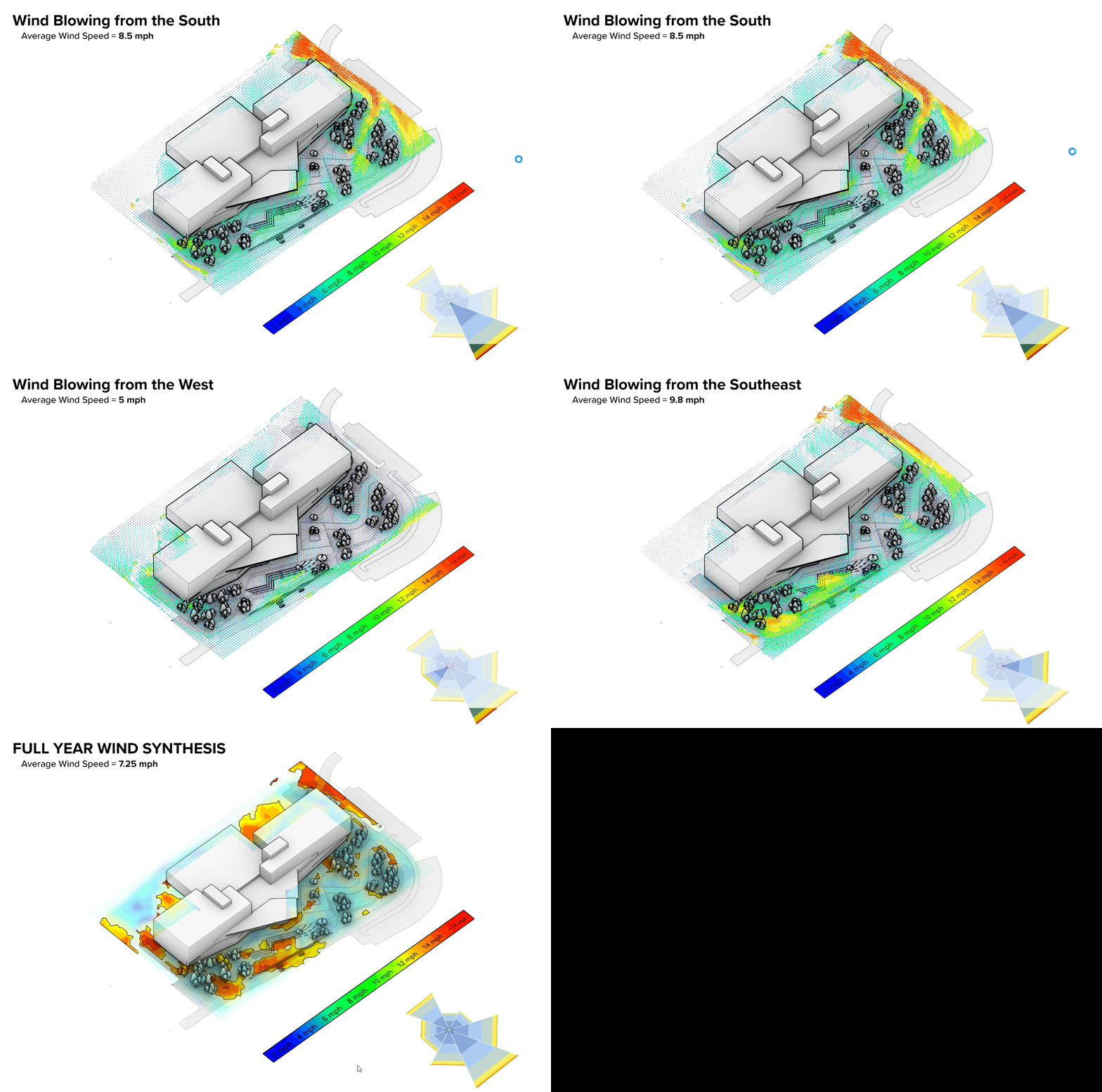
Structure such a center is not a one-time task however a continuous procedure of refinement. It requires a willingness to purchase expensive infrastructure and a management design that trusts engineers to direct their own work. In the high-stakes environment of 2026, this method is the only way to make sure that a business stays at the cutting edge of technical advancement and market importance.

Table of Contents
- – Technical Architectures for Modern Innovation ...
- – Facilities Requirements for High-Velocity Res...
- – Strategic Talent Combination and Movement
- – Data Sovereignty and Intellectual Residential...
- – Determining Efficiency in Collaborative Envir...
- – The Function of Physical Style in Technical O...
- – Looking Toward 2027 and Beyond
Latest Posts
What Makes a Community Truly Resilient to Market Shifts?
Why Boundary Defense Is Dead in Distributed R&D Networks
The Plan for a Truly Smart Corporate Research Study Center
Latest Posts
What Makes a Community Truly Resilient to Market Shifts?
Why Boundary Defense Is Dead in Distributed R&D Networks
The Plan for a Truly Smart Corporate Research Study Center